

♥ Wishlist
Compare 26 DeWalt Combi Drills products in Canada. Reviews, ratings, pros, cons and buying advice updated for October 2026.


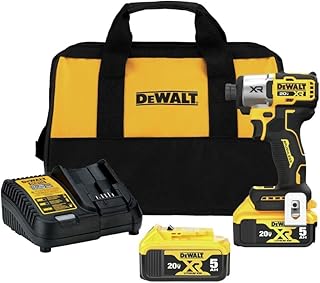


A good combi drill should do more than simply spin a drill bit. For Canadian homeowners, renovators, tradespeople and serious DIY users, the right DEWALT combi drill needs to balance drilling performance, hammer-drilling capability, fastening control, battery efficiency, ergonomics and long-term durability. The most suitable model depends on the materials you work with, the size of fasteners and drill bits you use, how frequently the tool will be operated, and whether you already own compatible DEWALT batteries.
The term “precision” is particularly important when comparing cordless combi drills. Maximum torque alone does not determine how controllable a drill feels. A well-designed tool should provide a useful range of clutch settings, a responsive variable-speed trigger, dependable electronic control and a chuck capable of holding accessories securely. These details become especially noticeable when moving between delicate cabinet hardware, general woodworking, structural fastening and masonry drilling.
A combi drill, also called a hammer drill/driver, combines three primary functions in one cordless tool: conventional drilling, screwdriving and hammer drilling. This makes it more versatile than a standard drill/driver, particularly when a homeowner wants one battery platform for a wide variety of jobs.
A combi drill is not automatically the best tool for every masonry job. Frequent drilling into hard concrete may justify a dedicated rotary hammer, while very small precision tasks may be better served by a compact drill/driver. The advantage of a combi drill is versatility rather than specialization.
DEWALT cordless tools are commonly organized around battery platforms, with 20V MAX being a major cordless system in the North American market. When comparing models, do not judge the tool solely by the voltage printed on the package. Battery capacity, motor design, electronics, gearing and the specific drill's construction all influence real-world usefulness.
Battery capacity is generally expressed in amp-hours. A higher-capacity battery can provide greater operating time, although it can also add weight. For overhead work, furniture assembly and routine household jobs, a compact battery may make the drill easier to control. For prolonged drilling or fastening, a higher-capacity battery can reduce battery changes.
Torque indicates the rotational force available from the drill. High torque can be useful when driving larger fasteners or drilling with larger accessories, but maximum torque should not be treated as a direct measure of overall quality.
A drill with excessive torque can actually be harder to control during delicate work if the user does not have a well-calibrated clutch and a responsive trigger. When comparing DEWALT models, consider maximum torque alongside clutch adjustment, speed control, gearing, chuck design and overall ergonomics.
A two-speed gearbox gives the user a choice between higher rotational speed and greater low-speed control. The lower gear is generally appropriate for demanding drilling or fastening where mechanical advantage is useful, while the higher gear is better suited to faster drilling in applications that do not require as much torque.
This distinction matters because operating every task at the highest available speed is not necessarily efficient. Matching the gear to the accessory and material can improve control, reduce unnecessary heat and help the tool perform more consistently.
The adjustable clutch is one of the most important features for precision fastening. Instead of allowing the motor to continue applying maximum force, the clutch can disengage at a selected resistance level.
For cabinet screws, trim, electrical boxes and other smaller fasteners, a lower setting can help prevent stripped screw heads and damaged surfaces. Higher settings can be appropriate for larger fasteners when the application requires more driving force.
Do not assume that a higher clutch number means a universally better setting. The correct adjustment depends on the fastener, material, screw length and required seating depth.
Many modern cordless combi drills use a 13 mm keyless chuck, although specifications vary by model. A larger chuck can accommodate a broader range of accessories, while the quality of the chuck affects how securely bits and drill accessories remain held during use.
For precision work, pay attention to smooth operation, ease of bit changes and how confidently the chuck can be tightened. A good chuck should make accessory changes straightforward without becoming a source of excessive wobble or slippage.
A variable-speed trigger gives the operator finer control over rotational speed. This is particularly valuable when starting a hole, positioning a screw, working with small drill bits or drilling materials that require controlled cutting rather than maximum speed.
Trigger response can make a substantial difference to perceived precision. A drill that responds smoothly to small trigger movements is generally easier to use for controlled starts than one that quickly jumps to a high speed.
One of the most important distinctions between cordless drills is motor technology. Brushless motors eliminate the traditional mechanical brushes used in brushed motors and use electronic control instead.
A brushed motor is not automatically unsuitable for occasional DIY work. If the drill will only be used for assembling furniture, hanging shelves and completing infrequent household projects, a simpler model may meet the user's requirements without paying for features that will rarely be used.
For frequent renovation, construction, maintenance or professional work, brushless technology is generally worth considering because efficiency, durability and performance under repeated use become more important.
Choosing the smallest or most powerful drill simply because its headline specification looks attractive can lead to the wrong purchase. Compact and high-torque drills serve different priorities.
The trade-off is usually size and weight. More power can be useful, but carrying a heavy drill for an entire workday is not necessarily preferable to using a compact model that can comfortably handle the majority of the intended applications.
Homeowners generally benefit from a versatile model with straightforward controls, a comfortable grip, adjustable clutch settings and enough power for routine drilling and fastening. A compact brushless model can be particularly attractive when the drill needs to cover many household tasks without becoming unnecessarily bulky.
DIY users who regularly build furniture, install shelving, work with timber and occasionally drill masonry should prioritize versatility. A two-speed gearbox, hammer mode, good clutch range and compatible battery ecosystem can be more valuable than simply selecting the highest torque specification.
Woodworking places a premium on control. Smooth variable-speed operation, dependable clutch adjustment, low-speed control and a compact form factor can be more important than maximum impact performance.
For larger woodworking projects, accessory selection is equally important. A high-quality brad-point bit, countersink, auger bit or hole saw can influence results as much as the drill itself.
Installation work often involves repetitive drilling and fastening in awkward positions. A compact drill with good balance, a work light and accessible controls can reduce fatigue. If the work includes larger holes through framing or other demanding applications, additional torque and battery capacity may become more important.
Tradespeople should evaluate the drill as part of a complete tool system. Battery compatibility, charger availability, runtime, durability, accessory compatibility and serviceability may matter more than one isolated specification.
Wood drilling is relatively easy for a capable combi drill, but precision depends heavily on using the correct accessory and speed. Standard twist bits can work for some applications, while brad-point bits are often preferred when accurate hole placement and cleaner entry are important.
When drilling through finished surfaces, placing a sacrificial backing board behind the workpiece can help reduce breakout on the exit side. Clamping the material securely also improves accuracy and safety.
Metal drilling requires more attention to speed, pressure, bit selection and heat management. High-speed operation is not automatically better. Excessive speed can generate heat rapidly and shorten the useful life of a cutting accessory.
For larger holes, step drilling can be preferable to immediately forcing a large bit through thick material. The accessory manufacturer's recommendations should always take priority over generic speed guidance.
The hammer function is what differentiates a combi drill from a conventional drill/driver. It combines rotation with a percussion mechanism designed for suitable masonry materials.
However, the phrase “hammer drill” should not be confused with “rotary hammer.” A rotary hammer is purpose-built for more demanding masonry and concrete work and normally provides substantially different impact mechanics. If drilling hard concrete is a frequent requirement, a dedicated rotary hammer may be the more appropriate tool.
Battery choice can change the feel of a cordless drill significantly. A compact battery may keep the overall package light and maneuverable, while a larger-capacity battery can provide greater runtime for prolonged work.
Cold Canadian conditions can also affect battery performance. Lithium-ion batteries generally perform best within their specified operating temperature range. Extremely cold batteries may deliver reduced performance, so users working outdoors during winter should follow the battery manufacturer's storage, charging and operating recommendations.
Battery capacity should therefore be matched to the job rather than selected solely on the basis of the largest available amp-hour rating.
A combi drill is held in one hand for extended periods, often at awkward angles. Balance, grip shape, trigger position and total weight all influence usability.
An LED can improve visibility around fasteners and drill points, particularly inside cabinets, under counters and in dim areas. The location and timing of the light can vary between models, so buyers who frequently work in confined spaces should examine the design rather than simply looking for the word “LED” in a specification list.
A belt hook is useful for installers and tradespeople who frequently climb ladders or move between work areas. It is less important for someone who mainly uses the drill at a workbench or around the home.
An auxiliary handle can improve control for demanding applications. Compact drills may prioritize maneuverability, whereas larger models may provide additional handling options for higher-force work.
Depending on the model, cordless drills can incorporate electronic systems designed to manage overload, overheating or other demanding operating conditions. Buyers should consult the specific model documentation rather than assuming that every DEWALT drill has identical electronic features.
DEWALT offers cordless drills across different performance and size categories, so the model family matters. Buyers should compare the actual specifications of individual models rather than assuming that a newer or more expensive tool is automatically better for every task.
Other established power-tool manufacturers, including Milwaukee, Makita, Bosch and Metabo, also offer competing cordless drill platforms. Comparing them can be useful if you are not already committed to a particular battery ecosystem.
Both brands offer extensive cordless ecosystems and drills across compact, general-purpose and high-performance categories. The better choice depends heavily on the user's existing batteries, desired ergonomics, tool dimensions and specific model specifications rather than brand reputation alone.
Makita is another major cordless-tool manufacturer with a broad range of drill/driver and hammer-drill options. Buyers should compare complete tool weight, dimensions, clutch control, chuck design, battery platform and intended workload.
Bosch offers a wide range of professional and DIY-oriented cordless tools. A useful comparison should focus on the specific models being considered rather than assuming one brand universally outperforms the other.
Maximum torque is only one specification. A drill that has enormous torque but poor ergonomics may be less useful for everyday work than a lighter model with better control.
Comparing bare-tool specifications without considering the battery can give an incomplete impression of the final package. Battery size affects both runtime and weight.
More powerful does not necessarily mean more appropriate. If most tasks involve small fasteners and routine holes, an oversized drill may add unnecessary bulk.
Hammer mode expands the drill's capabilities, but it does not turn the tool into a dedicated rotary hammer. Match the machine to the frequency, diameter and hardness of the masonry work.
A premium drill paired with poor-quality or unsuitable accessories can produce disappointing results. Bits should be selected for the material, hole size and drilling method.
When comparing listings, verify whether the package contains the bare tool, battery, charger, case or other accessories. Kit configurations can vary, and the lowest-looking price may not represent the lowest total cost of ownership.
When two models appear similar, use a structured comparison rather than choosing based on one headline specification.
Canadian shoppers often encounter cordless drills sold in more than one configuration. A bare tool normally makes the most sense for someone who already owns compatible batteries and chargers. A complete kit can be more practical for someone entering the battery platform for the first time.
Do not compare a bare-tool price directly with a kit price without accounting for the battery and charger. The kit may represent better overall value for a new user, while the bare tool may be more economical for an established DEWALT owner.
Product listings can differ in the way they present technical information. Before purchasing, verify the exact model number and compare the manufacturer's stated specifications with the retailer's listing.
Routine maintenance can help keep a cordless drill operating reliably. Always follow the model-specific instructions supplied by the manufacturer.
Cordless-tool batteries are a significant part of the investment, so proper handling matters. Use the charger specified for the battery platform and follow the manufacturer's charging instructions.
For seasonal users in Canada, storage conditions deserve additional attention. Extremely hot or cold environments can affect battery performance and may be unsuitable for long-term storage. Keeping batteries in an appropriate indoor environment and following DEWALT's published storage guidance is preferable to leaving them exposed to severe outdoor temperatures.
Read the instruction manual for the exact drill before use. Wear appropriate eye protection, secure loose workpieces and select accessories that are suitable for the intended material and operating mode.
Precision comes from the combination of tool settings, accessory quality and operator technique. Even a highly capable drill cannot compensate for a dull bit, unstable workpiece or incorrect speed.
Long-term value is broader than initial purchase price. A drill can be a better investment when it fits an existing battery ecosystem, handles the majority of the user's tasks, has an appropriate build quality and avoids unnecessary features that will rarely be used.
For frequent users, brushless technology, ergonomic design, battery compatibility and suitable performance headroom may justify moving into a higher tier. For occasional users, a more affordable model can make more sense when it still provides the required drilling, fastening and hammer-drilling functions.
A DEWALT combi drill is a strong option for buyers who want one cordless tool capable of handling common drilling, screwdriving and occasional masonry tasks. It is particularly attractive to users already invested in the DEWALT battery ecosystem because compatible batteries can potentially be shared across multiple tools.
It may be less suitable for someone who primarily performs specialized work. A dedicated impact driver can be preferable for repetitive fastening, while a rotary hammer is better suited to extensive concrete drilling. A lightweight drill/driver can also be sufficient when hammer drilling is never required.
The best model depends on the homeowner's workload. A compact model can be preferable for furniture assembly, shelving and routine repairs, while a more powerful brushless model may be better for regular renovation work. Compare the size, weight, battery requirements, clutch control and intended applications before choosing.
Models with a hammer-drilling function can be suitable for appropriate masonry applications when paired with the correct masonry accessory. For frequent or demanding concrete drilling, a rotary hammer is generally the more specialized choice.
Brushless technology is particularly worth considering for frequent users who value efficiency, reduced motor brush wear and performance under demanding cordless workloads. Occasional users may find that a less expensive configuration provides everything they need.
No. Higher torque provides greater capability for demanding fastening and drilling, but controllability, clutch adjustment, weight, balance and accessory selection are equally important. The best drill is the one whose performance matches the work you actually perform.
The appropriate battery depends on the application. Compact batteries can improve maneuverability and reduce weight, while higher-capacity batteries can provide longer operating time. Consider the complete tool-and-battery combination rather than amp-hours alone.
Battery compatibility depends on the specific DEWALT battery and tool platform. Buyers should verify compatibility for the exact models rather than assuming that all DEWALT batteries and tools are interchangeable.
A combi drill adds a hammer-drilling function to conventional drilling and screwdriving. A drill/driver normally focuses on drilling and fastening without the percussion mechanism used for hammer drilling.
A hammer drill combines rotation with a hammering action suitable for lighter masonry applications. A rotary hammer is designed for more demanding masonry and concrete work and uses a different impact mechanism. For extensive concrete drilling, the rotary hammer category is generally more appropriate.
Buyers who already have compatible batteries and a charger may prefer a bare tool. Someone entering the platform may find a kit more practical because it can include the battery and charging equipment needed to operate the drill.
The chuck is important because it holds the drilling and fastening accessories. Capacity, gripping performance, ease of adjustment and smooth operation should all be considered when comparing models.
Start with the exact model numbers, then compare torque, speed, chuck capacity, dimensions, weight, motor type, clutch settings, hammer function, battery platform and included accessories. Finally, compare current retailer pricing and customer feedback before making the purchase.
The best precision DEWALT combi drill for 2026 is not necessarily the most powerful or most expensive model. The right choice is the one that provides the appropriate combination of control, drilling capability, fastening performance, ergonomics, battery compatibility and durability for the work you actually intend to perform.
For Canadian buyers, the most useful comparison starts with the battery ecosystem and intended applications, then moves to motor technology, torque, speed, clutch control, chuck capacity and tool dimensions. A compact drill may be the smarter everyday choice for installation and household work, while a high-performance brushless model can make more sense for demanding renovation or trade applications.
Before purchasing, compare the exact specifications, kit contents and current customer feedback for the individual models under consideration. Check today's prices from trusted Canadian retailers and make sure the selected battery and charger configuration fits your existing tools. Taking this approach makes it easier to identify genuine differences between DEWALT combi drills and choose a model that offers useful capability rather than paying for specifications you may never use.