

♥ Wishlist
Compare 19 Dewalt Heat Gun for Canadian Shoppers products in Canada. Reviews, ratings, pros, cons and buying advice updated for October 2026.


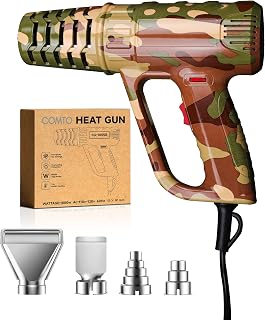


A precision heat gun is more useful than a simple high-temperature blower when the job requires controlled heating, repeatable results, and careful work around sensitive materials. For Canadian buyers, the most important decision is not simply maximum temperature. Airflow, temperature adjustment, nozzle design, power source, ergonomics, stability, and compatibility with the intended application can have a much greater effect on day-to-day usefulness.
DEWALT's current heat-gun range includes corded models such as the D26950 and D26960, as well as the 20V MAX cordless DCE530B. The D26960 family is particularly relevant when precise temperature adjustment matters because its LCD interface allows temperature changes in 50-degree increments and incorporates overload protection. The DCE530B is aimed at jobs where portability and access to confined areas are more important than having a continuously adjustable corded heat source.
Precision does not necessarily mean the tool reaches a higher temperature. A precision-oriented heat gun gives the operator better control over how heat is delivered to the workpiece. That control can come from finer temperature adjustment, predictable airflow, interchangeable nozzles, stable positioning, or a design that makes it easier to keep the tool at a consistent working distance.
The D26960 is designed for users who want more direct control over operating temperature. DEWALT specifies temperature adjustment in 50-degree increments, along with overload protection. It also includes a built-in kickstand, hang ring, cord protector, and ergonomic grip. Its compact design is listed at 2.3 pounds, making it a practical option when controlled corded heating is the priority.
For precision-oriented work, the LCD temperature display is one of the most important features to evaluate. Instead of judging heat solely from the appearance or response of the material, the operator can select a defined temperature setting and then adjust the technique according to the workpiece.
The D26960K builds around the D26960 platform and adds a broader accessory package. DEWALT lists a fishtail surface nozzle, cone nozzle, additional accessories, and a kit box. This configuration can make more sense for buyers who expect to work on several types of applications rather than purchasing a basic heat gun and sourcing accessories separately.
When comparing a kit with a tool-only configuration, consider whether the included accessories are genuinely useful for your projects. A larger accessory count is not automatically better if most of the attachments will remain unused.
The DCE530B is the cordless option in DEWALT's current Canadian heat-gun range. DEWALT specifies a maximum output temperature of up to 990°F (532°C), two temperature settings, 6.7 CFM airflow, lock-on and lock-off controls, and an LED work light. The tool is sold without a battery and charger, so buyers already invested in the DEWALT 20V MAX battery platform may have a different overall ownership calculation from someone starting a new battery system.
Its cordless design is particularly useful where a power cord would restrict movement. It can be practical for heat-shrinking wire tubing, decal removal, and similar localized jobs where portability is more valuable than the finer temperature adjustment offered by a corded LCD model.
The choice between corded and cordless should be based on the working environment rather than on the assumption that one power source is universally superior.
Temperature range is one of the most visible specifications on a heat gun, but it should not be evaluated in isolation. A very high maximum temperature is useful only when the application actually requires it. For delicate materials, excessive heat can deform, discolor, scorch, soften, or otherwise damage the workpiece.
A better approach is to match the heat gun's controllability to the material. If you routinely work with heat-sensitive plastics, adhesives, electrical components, films, finishes, or other materials where overheating is a concern, finer adjustment can be more valuable than simply buying the model with the highest advertised temperature.
DEWALT's D26960 provides temperature adjustment in 50-degree increments, while the DCE530B uses two temperature settings. Those different control philosophies are important when comparing the models for precision applications.
Airflow determines how much heated air reaches the target and how quickly that air moves across the work surface. A heat gun with high temperature but poorly matched airflow may not produce the result expected for a particular application.
For precision work, avoid automatically assuming that maximum airflow is the best setting. Concentrated heating can be desirable when removing a localized adhesive or heating a small component, while broader airflow can be more appropriate when warming a larger surface evenly.
The DCE530B is specified at 6.7 CFM on its high setting. When comparing different models, look at airflow alongside temperature settings, nozzle compatibility, and the intended application rather than ranking tools using one specification alone.
Nozzles are one of the easiest ways to change how a heat gun behaves at the work surface. The shape of the attachment influences how concentrated or distributed the heated airflow becomes.
Before buying additional accessories, check the nozzle dimensions and the manufacturer's compatibility information. The DCE530B uses a standard-size nozzle interface intended to accept attachments from corded units and other brands, but compatibility should still be confirmed for a specific accessory before purchase.
An LCD temperature interface can reduce guesswork when an application benefits from repeatable settings. The D26960's 50-degree adjustment increments are especially relevant to users who want more control than a basic two-setting heat gun provides.
Overload protection is a useful protective feature because heat guns operate at demanding temperatures. DEWALT states that the D26960's built-in overload protection shuts down the heating element to help prevent overheating of the tool.
A built-in kickstand can be valuable when the tool needs to remain in a stable position while the operator handles another object. It can also make cooling and temporary placement more manageable, although the heat gun should always be positioned according to the manufacturer's safety instructions and kept away from combustible surfaces.
For repetitive applications, lock-on operation can reduce the need to continuously hold the trigger. The DCE530B includes lock-on and lock-off controls. This can be useful when the operator needs more consistent hands-free operation, provided the work area is set up safely.
The DCE530B includes an LED intended to illuminate darker work areas. This is a secondary feature rather than a substitute for proper workplace lighting, but it can be useful when working around vehicle interiors, cabinets, equipment, or other confined locations.
Heat guns can be used for a broad range of controlled heating tasks, but the appropriate temperature varies considerably by material. Always consult the material manufacturer's instructions where available.
Maximum temperature is an easy specification to compare, but it does not tell you how accurately the heat can be controlled. For many detailed projects, a model with better temperature adjustment may be more useful than one with a higher maximum setting.
A cordless heat gun can be extremely convenient, but the battery requirement should be included in the purchasing decision. Conversely, a corded model may be the better choice if the tool will spend most of its time at a workbench.
A kit containing numerous attachments can appear attractive, but accessory value depends on your actual applications. Compare the included nozzles and other items with the attachments you expect to use.
More heat is not automatically faster or better. Excessive heat can damage surfaces and materials. Start with the lowest practical setting and increase the temperature gradually when the application allows it.
The distance between the nozzle and workpiece changes the amount of heat delivered to the surface. Holding the nozzle extremely close can create a concentrated hot spot and increase the possibility of damage. Follow the manufacturer's instructions and adjust distance and movement according to the material.
For cordless models, include batteries and chargers when necessary. For corded models, consider whether the supplied accessories cover your intended applications. A slightly different initial purchase can produce a substantially different overall value depending on what you already own.
A simple comparison checklist can make the buying process much more useful than relying on star ratings alone.
DEWALT is not the only brand worth considering when shopping for a heat gun in Canada. Depending on the application, buyers may also compare models from Milwaukee, Makita, Bosch, Wagner, Master Appliance, and other established tool manufacturers.
The strongest comparison is based on specifications rather than brand recognition alone. Compare temperature adjustment, airflow, nozzle options, power source, ergonomics, control layout, warranty terms, accessory availability, and the manufacturer's documentation for the exact model.
For a buyer already invested in DEWALT 20V MAX batteries, the DCE530B can have a practical system advantage because the battery platform may already be part of the user's tool collection. A buyer who does not own compatible batteries should compare the complete cordless setup rather than treating the bare-tool price as the final cost.
A corded model is often the logical choice for workshop, renovation, repair, and bench applications where the heat gun will remain close to an electrical outlet. It avoids battery changes and can be convenient for extended work sessions.
The D26960 is particularly interesting for buyers whose definition of precision involves temperature adjustment. Its LCD display and 50-degree increments provide a more granular control approach than the two-setting DCE530B cordless model.
The DCE530B is better aligned with mobile applications. Its compact cordless design can be useful when a cord would interfere with access or movement. This is particularly relevant to contractors, automotive users, maintenance workers, and DIY users who already carry DEWALT 20V MAX batteries.
However, cordless convenience should be weighed against battery runtime, charging requirements, and the fact that the tool-only configuration does not include a battery or charger. DEWALT lists up to 42 minutes of runtime under a specified low-setting test condition using a DCB205 5Ah battery, so real-world runtime should not be interpreted as a universal figure for every application or temperature setting.
Heat guns can produce temperatures high enough to cause burns, ignite combustible materials, damage finished surfaces, or create hazardous fumes from unsuitable materials. Treat a heat gun as a high-temperature power tool rather than as an ordinary household blower.
Paint removal is one of the traditional uses for a heat gun, but it requires particular care. Older painted surfaces can present hazards, and heating unknown coatings may produce harmful fumes. Do not assume that every painted surface is suitable for heat-assisted removal.
When a coating is known to be appropriate for heat-assisted removal, work methodically rather than concentrating extreme heat on one location. Keep the tool moving as required, use an appropriate nozzle, and follow the manufacturer's safety instructions. If the age or composition of a coating is uncertain, investigate the coating before applying heat.
Heat-shrink tubing is an application where controlled heat can be especially valuable. The objective is normally to heat the tubing sufficiently for it to contract around the underlying connection without unnecessarily overheating nearby insulation, connectors, wiring, or other components.
A precision-oriented heat gun can make this process easier because the operator can select a suitable setting and control the distance and movement of the nozzle. A hook or similar nozzle may help direct heat around cylindrical tubing, while a broader nozzle can be useful when more even heating is required.
Heat can soften some adhesives and make decals easier to remove, but the substrate underneath the adhesive is just as important as the adhesive itself. Painted metal, plastic trim, finished wood, glass, and other surfaces can respond very differently to heat.
Apply moderate heat first and observe how the adhesive responds. Avoid concentrating heat in one location for too long. A scraper or removal tool should be selected according to the surface so that the mechanical part of the process does not create unnecessary scratches or gouges.
Look for both the maximum temperature and the available adjustment method. A maximum figure describes the upper capability; it does not describe the level of control available throughout the range.
Airflow is normally expressed as a volume per unit of time. Compare airflow figures only when they are measured under comparable conditions. A higher number does not automatically mean better performance for every task.
Corded and cordless models use different power systems. For Canadian purchases, verify that the exact model is appropriate for the electrical system and market in which it will be used.
Weight becomes more important during repetitive work or when the heat gun must be held at a fixed position for longer periods. Also consider balance rather than looking at weight alone.
Accessories can affect practical value considerably. A heat gun with the right nozzle can be more useful for a particular application than a nominally more powerful model with unsuitable attachments.
Customer ratings can help identify recurring issues, but a single overall rating rarely explains whether a heat gun is appropriate for a specific application. Read reviews for information about the actual characteristics that matter to your intended use.
Prices can change because of promotions, kit configurations, retailer policies, regional availability, and whether a product is sold as a bare tool or complete kit. For that reason, a current price should be checked immediately before purchase rather than treated as a permanent specification.
When comparing Canadian listings, make sure the model numbers are identical. A similar-looking heat gun can have a different accessory package, power configuration, battery inclusion, or regional specification. Compare the complete package rather than comparing headline prices alone.
Proper maintenance can help preserve the tool and its accessories. Follow the manufacturer's maintenance instructions rather than applying generic servicing procedures to electrical components.
A precision-oriented DEWALT heat gun is worth considering for DIY users, tradespeople, maintenance workers, automotive users, electricians, renovators, and workshop users who need controlled heat rather than a general-purpose airflow tool.
The right configuration depends on the work. A corded LCD model is more compelling when temperature adjustment and prolonged workshop operation are priorities. A cordless 20V MAX model is more compelling when portability and access are the main concerns.
If the heat gun will be used only occasionally for simple tasks, advanced temperature control, multiple accessories, and a cordless battery platform may not provide enough additional value to justify the extra cost. In that situation, compare simpler models based on the exact application and required temperature range.
Likewise, buyers who require highly specialized laboratory, industrial, or process-heating equipment should not assume that a general-purpose handheld heat gun is an appropriate substitute. Specialized applications may require calibrated temperature control, specialized airflow characteristics, or equipment designed for continuous industrial operation.
The DEWALT D26960 is a strong option to consider when incremental temperature adjustment is the priority. DEWALT specifies 50-degree temperature adjustment increments and an LCD display, making it substantially more control-oriented than a basic two-setting heat gun.
The DCE530B has two temperature settings rather than the incremental LCD temperature adjustment used by the D26960. It is designed primarily around cordless portability and access to locations where a corded heat gun is inconvenient.
The DCE530B is a tool-only configuration, so the battery and charger are sold separately. DEWALT also lists a DCE530P1 kit configuration that includes a battery and charger. Always confirm the exact package before purchasing.
DEWALT specifies a maximum output temperature of up to 990°F (532°C) under its stated test conditions. The maximum figure should not be interpreted as the recommended setting for every application.
No. Maximum temperature is only one specification. For precision work, temperature adjustment, airflow, nozzle design, stability, ergonomics, and the ability to control heat at the work surface can be equally or more important.
Yes. DEWALT specifically identifies heat shrinking wire tubing as an application for its DCE530B cordless heat gun. The correct operating temperature and technique should still be determined according to the tubing and component manufacturer's instructions.
Yes. Plastics vary significantly in their response to heat. Excessive temperature or prolonged heating can soften, warp, discolor, or otherwise damage plastic. Use the lowest practical temperature and follow the material manufacturer's recommendations.
Heat can be useful for softening some decal adhesives, and DEWALT identifies decal removal as an application for the DCE530B. The underlying surface must also be considered because excessive heat can damage paint, plastic, finishes, or other substrates.
Choose based on the type of control you need. The D26960 is more suitable when incremental temperature adjustment and corded operation are important. The DCE530B is more suitable when cordless mobility, compact access, and DEWALT 20V MAX battery compatibility are more important.
DEWALT positions its heat guns for a range of professional and DIY applications. Whether a particular model is suitable for your professional workflow depends on operating duration, temperature requirements, portability, accessories, and the demands of the specific job.
Confirm the exact model number, voltage, corded or cordless configuration, included accessories, battery and charger status, manufacturer's Canadian documentation, retailer terms, and current price. These details can differ between product configurations and markets.
The best precision DEWALT heat gun is the one whose temperature control, airflow, power source, nozzle configuration, and ergonomics match the work you actually perform. For buyers focused on controlled temperature adjustment, the D26960 and D26960K deserve close attention. For users who value cordless mobility and already participate in the DEWALT 20V MAX ecosystem, the DCE530B offers a different set of advantages.
Before making a final decision in Canada, compare the exact model specifications, included accessories, current customer feedback, and today's retailer pricing. Most importantly, choose based on the application rather than maximum temperature alone. A heat gun that gives you the right level of control is generally more useful than one that simply advertises the highest number.