

♥ Wishlist
Compare 28 DeWalt Reciprocating Saw for Cutting and Demolition products in Canada. Reviews, ratings, pros, cons and buying advice updated for October 2026.


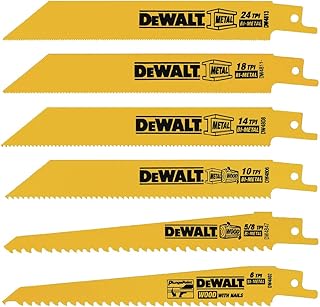


Choosing the right DeWalt reciprocating saw involves more than comparing advertised power or selecting the newest model. A reciprocating saw is a high-speed cutting tool, and the best choice depends on the materials you expect to cut, the frequency of use, the type of worksite, available power sources, blade requirements and the level of control you need. For Canadian buyers, those considerations can also include cold-weather working conditions, corded versus cordless operation, battery compatibility and the availability of replacement blades and accessories.
This buying guide is designed to help compare DeWalt reciprocating saw options by the specifications that actually affect everyday cutting performance. Product specifications, included accessories, battery configurations and retailer pricing can change, so always check the current listing and manufacturer information before purchasing.
Reciprocating saws are primarily designed for fast, practical cutting rather than the fine finish associated with a jigsaw or circular saw. The term precision is therefore best understood as controlled cutting: maintaining a predictable blade path, managing vibration, positioning the shoe correctly and selecting a blade appropriate for the material.
DeWalt reciprocating saws can vary considerably in size and configuration. Some are designed for heavy demolition and demanding construction work, while compact versions can be easier to position in confined spaces. A professional user cutting pipe, framing lumber and construction materials throughout the day may value different characteristics from a homeowner performing occasional renovation work.
Specification sheets can look similar at first glance, but several measurements have a direct effect on how a reciprocating saw behaves. Instead of focusing on one headline number, compare the complete specification set and consider how each feature relates to your intended work.
Strokes per minute indicate how rapidly the blade moves through its reciprocating cycle. A higher maximum stroke rate can support faster cutting in suitable materials, but maximum speed alone does not guarantee better results. The correct speed depends on the blade, material and cutting technique.
Variable-speed operation is particularly useful because aggressive cutting in wood may require a different approach from controlled cutting in metal. A trigger that allows progressive speed control can also make it easier to start a cut without immediately applying maximum speed.
Stroke length describes how far the blade travels during each reciprocating cycle. A longer stroke can remove more material per cycle and may be beneficial for demanding cutting applications. A shorter stroke can offer a different balance between control, compactness and cutting behaviour.
Do not treat stroke length as an isolated measure of performance. Motor output, electronic control, blade design, tooth configuration, material thickness and operator technique all influence actual cutting results.
Motor design matters when a saw is expected to maintain useful cutting performance under load. For occasional household work, outright power may be less important than handling and portability. For renovation, framing, demolition or repeated cutting, consistent power delivery can become much more important.
Cordless DeWalt models should also be evaluated according to their battery platform and the batteries already owned by the buyer. A bare tool can be attractive when compatible batteries and a charger are already available, while a complete kit may be more appropriate for someone entering the platform for the first time.
Weight affects how comfortably the saw can be positioned and held during repeated cuts. A heavier tool may provide a substantial feel, but additional weight can become tiring when cutting overhead or working from awkward positions.
Balance is equally important. Two tools with similar listed weights can feel different because of motor placement, battery position, handle design and overall geometry. When comparing models, consider whether most of your work will be performed at waist height, above shoulder level or in confined spaces.
A reliable blade clamp is essential because reciprocating saw blades experience substantial movement and cutting forces. Tool-free blade-change systems are convenient for users who frequently switch between wood, metal and specialty blades.
Check whether the saw's blade clamp accepts the blade types you intend to use and whether the mechanism allows practical access when wearing work gloves. The blade itself remains a major part of the cutting system, so compatibility and availability should be considered before buying.
Some reciprocating saw designs incorporate orbital action, which changes the blade's cutting movement. This feature can be useful in suitable wood-cutting applications where aggressive material removal is desirable, while straight reciprocating action can provide more controlled behaviour for many metal-cutting tasks.
Orbital action is not automatically better. Buyers should consider whether they actually need it and whether the model provides a way to select or disable the feature for different applications.
The corded-versus-cordless decision is one of the most important choices when comparing reciprocating saws. Both configurations can make sense, depending on the work environment.
Cordless reciprocating saws provide freedom of movement and eliminate the need to locate a suitable electrical outlet. This can be especially convenient during exterior renovation, demolition, roofing-related work and construction sites where extension cords would be inconvenient.
Corded reciprocating saws can be practical when the work is performed near a reliable electrical supply and long periods of continuous operation are expected. There is no need to stop for battery replacement or charging, although the power cord introduces another consideration on the worksite.
If you already use DeWalt cordless tools, platform compatibility can be one of the strongest reasons to select a particular reciprocating saw. A compatible bare tool may allow you to use existing batteries, reducing duplication of chargers and battery packs.
However, battery compatibility should always be confirmed for the exact model. Do not assume that every DeWalt battery, charger or voltage class is interchangeable simply because the products carry the same brand name.
For buyers starting from scratch, compare the cost and contents of a complete kit against the bare tool. Consider the battery capacity supplied, whether a charger is included and whether the kit contains accessories you would otherwise need to purchase separately.
For occasional renovation work, a compact cordless model can be attractive because it is easy to store and move around the house. Prioritize controllability, comfortable handling and convenient blade changes rather than selecting the most powerful model available.
Demolition places greater demands on the saw, blade and operator. A heavier-duty model with suitable power, durable construction and effective control may be preferable when cutting through framing, fixtures and other construction materials.
Demolition blades are often more important than buyers initially expect. A suitable blade can make a substantial difference when cutting nail-embedded wood, metal components or mixed construction materials.
A reciprocating saw can be useful for cutting plastic pipe, metal pipe and other components during renovation or installation work. For pipe cutting, controllability and access are particularly important because the workpiece may be located in a confined area.
Choose blades specifically intended for the material being cut and avoid assuming that a general-purpose wood blade is suitable for metal.
Tradespeople often need a saw that can move quickly between work locations and handle a range of cutting tasks. Cordless portability can be particularly useful, while compact dimensions can matter when access is restricted.
A reciprocating saw can be used for selected outdoor cutting tasks, including pruning when the tool and blade are appropriate for that application. A purpose-designed pruning blade should be considered instead of using a demolition blade for every outdoor task.
The saw is only one part of the cutting system. Blade selection can significantly influence speed, cut quality, durability and suitability for a particular material.
Wood-cutting blades generally use tooth configurations designed to remove wood efficiently. Coarser teeth can be useful for fast cutting, while finer configurations can provide more controlled cutting in appropriate applications.
Metal requires blades designed specifically for the material. Bi-metal blades are commonly used for demanding applications because their construction combines characteristics intended to balance flexibility and tooth durability. Blade selection should still be matched to the type and thickness of metal being cut.
Demolition blades are designed for difficult construction materials and applications where durability is more important than producing a refined edge. Some are intended for nail-embedded wood, while others are designed for mixed materials or heavy metal cutting.
Pruning blades are designed around the characteristics of branches and green wood. If a reciprocating saw will be used for outdoor pruning, select a blade intended for that purpose and follow the saw and blade manufacturers' operating guidance.
Tooth configuration and blade length should be selected according to the material and cutting situation. A blade that is excessively long for a confined application can be harder to control, while insufficient usable blade length can limit cutting capacity.
High cutting speed is useful only when the operator can control the tool effectively. Look closely at the ergonomic and practical features that affect everyday handling.
More power is not necessarily the best answer for every user. A high-performance demolition tool can be unnecessarily heavy or expensive for someone who only needs occasional cutting around the home. Match the tool to the workload instead of choosing specifications simply because they are larger.
For cordless tools, the advertised tool price may not represent the complete cost if the product is sold without batteries or a charger. Compare complete kit contents before deciding which option provides better value.
A powerful reciprocating saw cannot compensate for a blade that is poorly matched to the material. Using an unsuitable blade can reduce cutting performance, increase wear and make the job more difficult.
Maximum strokes per minute can look impressive on a specification sheet, but controlled speed is often more useful than maximum speed. Different materials require different cutting approaches, and variable-speed operation can provide greater flexibility.
A saw that is excellent for open demolition work may be inconvenient in a narrow cavity. Consider the physical dimensions of the tool alongside its motor performance.
Bare tools can be an efficient choice for existing battery-platform users, but they are less convenient for first-time buyers who do not already have compatible batteries and chargers. Confirm exactly what is included in the current package.
DeWalt is not the only established manufacturer worth considering. Buyers comparing reciprocating saws may also encounter Milwaukee, Makita, Bosch and other recognized power-tool brands. The strongest choice depends on the complete tool ecosystem rather than brand reputation alone.
Compare the exact models rather than comparing brands in general. Battery-platform compatibility, tool size, speed control, stroke specifications, ergonomics, included accessories and current retailer pricing can vary substantially between individual products.
Makita offers a broad cordless power-tool ecosystem, so buyers already invested in that platform may find battery compatibility particularly important. If you already own DeWalt batteries and chargers, staying within the existing platform may provide greater practical convenience.
Bosch is another established power-tool manufacturer with products across multiple tool categories. Compare the intended application, physical dimensions, blade system, power configuration and ergonomics of specific models instead of relying solely on manufacturer reputation.
When evaluating a shortlist of ten DeWalt reciprocating saw options, use a consistent comparison framework. This makes it easier to identify which model actually fits your requirements rather than simply selecting the model with the largest specification numbers.
Customer reviews can provide useful information, but they should be interpreted alongside specifications and the intended application. Look for recurring patterns rather than giving too much weight to a single highly positive or negative comment.
Reviews are especially useful for practical characteristics that may not be fully captured in specification tables, such as perceived balance, ease of changing blades, comfort during repeated use, battery convenience and suitability for particular jobs.
At the same time, consider whether a reviewer's workload matches yours. A homeowner using a reciprocating saw a few times per year has different requirements from a professional contractor using the tool for extended periods.
Regular care can help maintain reliable operation and make problems easier to identify before they become serious. Always follow the current instructions supplied with the specific model, particularly for cleaning, inspection, lubrication and battery handling.
Reciprocating saws can cut rapidly through a wide range of materials, which makes safe preparation essential. Before cutting, identify the material and consider whether electrical wiring, plumbing, structural components or other hidden objects could be present behind the cutting surface.
Canadian buyers should compare the exact product configuration rather than relying solely on a model name. The same general tool family may appear in different packages containing different batteries, chargers or accessories.
Prioritize manageable weight, straightforward controls, cordless convenience if appropriate and a sensible overall kit configuration. There is little benefit in paying for professional-level features that will rarely be used.
A more capable cordless model can make sense when the saw will be used for repeated renovation projects. Variable-speed control, useful cutting capacity, ergonomic handling and a broad blade selection become increasingly important.
Professionals should place greater emphasis on durability, sustained usability, battery logistics, ergonomics, cutting performance and compatibility with the existing tool platform. Time spent changing batteries, blades or tools can become significant across a large number of jobs.
Demolition users should prioritize a robust design, suitable power delivery, effective vibration management, appropriate blade compatibility and easy servicing or accessory replacement. The right demolition blade is particularly important when dealing with nail-embedded wood or mixed construction materials.
The lowest purchase price is not necessarily the lowest overall cost. For cordless models, battery and charger requirements can materially change the initial investment. For frequent users, blade consumption and the need for additional batteries can also influence long-term ownership costs.
A sensible comparison should therefore consider the complete package: tool, batteries, charger, accessories, replacement blades and the expected workload. A slightly more expensive configuration may make more sense if it includes components that would otherwise need to be purchased separately.
There is no single best DeWalt reciprocating saw for every Canadian buyer. The right model depends on the intended workload, material, desired portability, battery platform, cutting requirements and budget. A compact model may be preferable for restricted spaces, while a heavier-duty model can be more appropriate for demanding demolition.
Many professional users choose cordless reciprocating saws because modern cordless platforms can provide substantial cutting capability without a power cord. However, suitability depends on the exact model, battery configuration, blade and workload. Compare the specifications of the specific saw rather than assuming all cordless models perform identically.
A bare tool can be a practical option when you already own compatible batteries and a charger. A complete kit can be more appropriate if you are new to the battery platform. Always verify exactly what is included in the current Canadian listing.
Yes, when the saw and blade are appropriate for the application. Use a blade specifically designed for the type and thickness of metal being cut, and follow the tool and blade manufacturer's instructions.
Yes. Reciprocating saws are widely used for cutting wood, including construction lumber and demolition materials. Select the blade according to the type of wood and whether the material contains nails or other embedded components.
Some reciprocating saws can be used with suitable pruning blades for appropriate outdoor cutting tasks. Use a blade designed for pruning and follow the manufacturer's instructions regarding the tool and application.
No. Blade length should correspond to the cutting application. Excessive blade length can make control more difficult in confined spaces, while insufficient usable length may limit the material that can be cut safely and effectively.
Stroke length is an important specification because it describes the blade's travel during each cycle. However, it should be evaluated together with stroke rate, motor performance, blade selection, tool balance and the material being cut.
There is no universal replacement interval. Replace a blade when it becomes excessively worn, damaged or unsuitable for producing the required cut. Cutting difficult materials can accelerate blade wear, so inspect the blade regularly rather than relying on a fixed schedule.
Tool and battery operating limits vary by model, so Canadian users should follow the manufacturer's specified temperature and storage guidance. Cold conditions can affect cordless battery behaviour, making appropriate storage, charging and handling particularly important during winter work.
Before choosing from a list of DeWalt reciprocating saws, verify the fundamentals first. Identify the materials and cutting tasks, decide between corded and cordless operation, confirm battery compatibility, compare stroke specifications and assess the physical size and weight of each candidate.
Next, examine the practical details: blade-change system, shoe design, variable-speed control, orbital-action settings, included accessories and kit contents. Finally, compare current Canadian retailer information, manufacturer specifications and recent verified customer feedback for the exact model.
The strongest purchase is not necessarily the model with the highest specification or the lowest advertised price. It is the reciprocating saw whose power, control, size, battery configuration, blade compatibility and overall package match the work you actually expect to perform.