

♥ Wishlist
Compare 43 Bosch Circular Saws for Powerful, Precise Cutting products in Canada. Reviews, ratings, pros, cons and buying advice updated for October 2026.







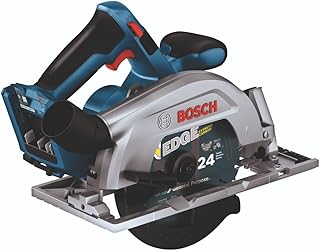


Choosing a Bosch circular saw for precision work involves more than comparing motor power or blade diameter. For Canadian buyers, the right saw should match the material being cut, the required cutting depth, the desired level of accuracy, the power platform already in your workshop, and the type of work you expect to perform. A saw intended for occasional plywood cuts has different priorities from one used for repeated framing, cabinetry, renovation, or professional carpentry.
This buying guide is designed to help you evaluate Bosch circular saw options systematically rather than choosing solely from a ranking position. Specifications can vary between models and regional configurations, so always compare the exact Canadian model number, included accessories, voltage platform, blade specification, and current retailer information before purchasing.
Precision in circular sawing comes from the interaction of several features rather than one specification. A powerful motor does not automatically produce a more accurate cut. Blade quality, base rigidity, depth and bevel adjustment, sight lines, ergonomics, vibration control, and the operator's cutting technique all contribute to the final result.
Bosch circular saws are available across corded and cordless categories, giving buyers different combinations of continuous power, portability, runtime, and convenience. The best choice depends on whether your priority is stationary workshop-style work, mobile construction work, finish carpentry, renovation, or general DIY use.
A corded circular saw can be an attractive choice when the work area has convenient access to mains power and extended cutting sessions are expected. There is no battery charging cycle to manage, and the saw can remain ready for repeated cuts. For workshops, renovation projects, and users who regularly make long sequences of cuts, corded equipment can offer a straightforward workflow.
The main trade-off is mobility. A power cord can interfere with positioning, become inconvenient around large sheets, and requires additional attention to keep it away from the blade path.
Cordless Bosch models are particularly useful when portability and unrestricted movement matter. They can be practical for construction sites, outdoor projects, roof work, framing, renovation, and locations where extension cords are inconvenient.
However, cordless performance should be evaluated as a complete system. Battery capacity, battery platform, charger compatibility, tool weight, expected workload, and the number of batteries available can all affect productivity. A cordless saw may be an excellent purchase for someone already invested in a compatible Bosch battery platform, while a corded model may make more sense for an occasional user who does not need additional batteries.
Compact saws can be useful for lighter materials, trim-related work, smaller boards, and projects where reduced size improves handling. They are not automatically superior for precision work, but their smaller form factor can make controlled cuts easier in confined spaces.
Full-size circular saws generally provide greater cutting capacity and are better suited to demanding construction materials and thicker stock. Buyers should still verify the actual maximum cutting depth at 90 degrees and at common bevel settings instead of assuming that a larger-looking saw will meet a particular requirement.
Cutting depth is one of the most important specifications to check before buying a circular saw. A model may have sufficient capacity for standard sheet goods while being unsuitable for thicker dimensional lumber or certain angled cuts.
Maximum depth is normally greatest at a 90-degree setting. Tilting the saw for a bevel cut changes the blade's relationship with the workpiece and normally reduces the available cutting depth. If your project involves frequent bevel cuts, evaluate the capacity at the actual angle you intend to use.
The blade is the cutting component that physically determines the character of the cut. Circular saws can accept different blade configurations depending on the model, so compatibility must be checked before purchasing replacement or specialist blades.
A blade with a lower tooth count can be useful where fast material removal is more important than a very fine finish. Higher tooth counts can be preferable for cleaner cuts in suitable materials, although feed rate, blade geometry, material type, and blade quality also matter.
Kerf refers to the width of material removed by the blade. A thinner kerf can reduce material waste and may require less cutting effort, but the correct blade must be compatible with the saw and appropriate for the intended application.
For clean woodworking cuts, avoid treating tooth count as the only selection criterion. Tooth geometry and the material being cut are equally important. A blade designed for framing lumber should not automatically be treated as the best choice for fine plywood or finished panels.
Motor power is an important consideration, particularly when cutting dense or thick material, but published electrical ratings should not be interpreted as a direct measurement of cutting performance. Real-world performance depends on the complete design of the saw, blade condition, material, feed pressure, cutting depth, and operating conditions.
A saw that is too small for the intended workload may require excessive feed pressure and can become frustrating during demanding cuts. Conversely, buying the most powerful model available may add weight and cost without providing meaningful advantages for lightweight DIY projects.
For commercial investigation, compare motor characteristics alongside cutting capacity, ergonomics, blade compatibility, adjustment quality, and the type of work you actually perform.
Bevel capability matters when a circular saw will be used for roofing, framing, furniture components, cabinetry, trim work, or other applications involving angled cuts. A useful bevel mechanism should be easy to adjust, secure firmly, and provide markings that allow the operator to return to commonly used settings.
When comparing Bosch circular saws, examine how easily the bevel adjustment can be reached while wearing work gloves and whether the base remains stable after the angle is changed. A theoretically capable bevel range is less useful if making adjustments is cumbersome during repeated cuts.
Depth control affects both safety and cutting quality. Setting the blade unnecessarily deep can expose more blade below the material and may increase the amount of unnecessary cutting. Setting the depth too shallow can prevent the blade from completing the cut cleanly.
For many woodworking applications, the objective is to set the blade only as deep as the material and cutting situation require. Always follow the manufacturer's instructions and appropriate safe operating practices for the particular saw.
A circular saw does not have to operate alone when straight, repeatable cuts are required. Depending on the Bosch model and accessory ecosystem, guide systems or compatible straightedge solutions can improve repeatability for sheet goods and long cuts.
Before purchasing a guide accessory, verify compatibility with the exact saw model. Do not assume that every Bosch circular saw uses the same guide interface or that an accessory designed for one generation or product family will automatically fit another.
Brushless motor technology is an important consideration in modern cordless power tools. Brushless systems eliminate traditional motor brushes and can offer design advantages related to efficiency, durability, heat management, and electronic control.
That does not mean every brushless saw is automatically the best purchase. A buyer should compare the entire tool system, including price, weight, battery requirements, cutting performance, intended workload, and available features. For occasional use, the additional cost of a higher-end platform may not provide enough practical benefit to justify the investment.
For cordless Bosch circular saws, battery compatibility can have a major influence on overall value. If you already own compatible Bosch batteries and chargers, staying within the same platform may reduce the need to purchase additional power equipment.
New cordless-tool buyers should calculate the cost of the complete system rather than looking only at the bare tool. Depending on the product configuration, a kit may include a battery and charger, while another listing may contain the tool only.
A circular saw must be controlled while the blade is rotating and cutting material, so ergonomics deserve serious attention. Weight distribution can affect how naturally the saw tracks along the intended path, particularly during long cuts or when working at awkward angles.
Consider the position of the main handle, auxiliary handle, trigger arrangement, base plate, adjustment controls, and balance point. If possible, compare the physical dimensions and weight of shortlisted models rather than relying on motor specifications alone.
A lightweight saw may be easier to maneuver, while a heavier professional model may provide a different balance and greater cutting capacity. Neither characteristic is universally better; the correct choice depends on the job.
Dust control has both cleanliness and visibility benefits. Wood dust can obscure a cutting line, accumulate around the work area, and make indoor projects more difficult to manage.
When comparing models, check whether the saw provides a suitable dust outlet and whether your intended vacuum or extraction setup is compatible. For indoor renovation and woodworking, dust management can be considerably more important than it appears from a basic specification table.
When cutting plywood, MDF, OSB, or similar sheet materials, prioritize a stable base, an appropriate fine-tooth or panel-cutting blade, good visibility, and a reliable straightedge or guide setup. Large sheets also require proper support to prevent movement and unwanted pressure on the blade.
Framing applications place greater emphasis on cutting capacity, durability, handling, and efficient material removal. A saw intended for frequent construction work should be evaluated for the workload rather than simply its advertised maximum speed.
Finish carpentry places a stronger emphasis on controlled cuts and surface quality. Blade selection becomes particularly important, and a guide or carefully secured straightedge may be worthwhile when a high degree of repeatability is required.
Renovation work can involve many different materials and working environments. Portability, visibility, dust management, bevel capability, and the ability to make controlled cuts in confined areas can all be useful. Cordless equipment may be attractive when moving around a renovation site frequently.
Occasional users generally do not need to maximize every specification. A dependable saw with appropriate cutting capacity, straightforward controls, compatible blades, and manageable weight can be a better value than an expensive professional model whose advanced capabilities will rarely be used.
Circular saws are high-speed cutting tools and should be operated according to the manufacturer's instructions. A buying guide should therefore consider safety-related design and operating requirements alongside performance.
Higher power does not automatically mean greater precision. A saw with excellent ergonomics, a rigid base, useful adjustment controls, and an appropriate blade can be more suitable for precision work than a more powerful but less controllable alternative.
Buyers sometimes concentrate on the saw and forget to check replacement-blade requirements. Verify blade diameter, arbor specifications, kerf requirements, maximum permitted blade speed, and material suitability before purchasing a replacement blade.
Part numbers and listing titles can differ in what is included. A tool-only configuration may require a separately purchased battery and charger, while a kit may include additional equipment. Check the exact contents before comparing prices.
Extra capacity is useful when you need it, but it can come with additional weight, size, or cost. Match the saw to the thickest and most demanding materials you actually expect to cut.
A specification sheet may look impressive while the tool is unnecessarily cumbersome for your projects. If precision and repeated controlled cuts are priorities, handling should be part of the purchasing decision.
Different materials and cut-quality requirements can call for different blades. A general-purpose blade may be convenient, but specialist blades can be more appropriate for particular woodworking, construction, or panel-cutting applications.
When comparing the models included in a shortlist, use the same criteria for every saw. This prevents a prominent specification from overshadowing characteristics that may be more important for your application.
Bosch is one of several established power-tool brands that Canadian buyers may encounter when comparing circular saws. Depending on the application, it can also be useful to evaluate alternatives from Makita, DEWALT, Milwaukee, Metabo HPT, and other established manufacturers.
The most useful comparison is not simply brand versus brand. Compare equivalent saw categories and specifications. A compact cordless saw from one manufacturer should not be judged directly against a heavy-duty corded model from another without accounting for the different intended applications.
Brand familiarity should be only one part of the decision. The best circular saw is the one whose specifications, accessories, power system, handling characteristics, and price fit the intended work.
Customer ratings can be useful, but an average score does not tell the entire story. A circular saw may receive positive feedback from framing users while being less suitable for someone seeking very fine woodworking cuts.
When reading verified customer reviews, look for repeated comments concerning cutting performance, blade changes, adjustment mechanisms, battery life where applicable, ergonomics, durability, dust control, and compatibility with accessories.
Before completing a purchase, verify the exact product information rather than relying solely on a general product name. Regional configurations can differ, and a photograph or abbreviated listing title may not communicate every important detail.
A precision saw is only as effective as the blade installed for the task. Blade selection should reflect the material and the desired finish.
Cut quality can deteriorate because of a dull, damaged, contaminated, or inappropriate blade. If the saw begins requiring unusual feed pressure, produces poor-quality cuts, or behaves differently from normal, stop and investigate rather than simply forcing the saw through the material.
Follow the manufacturer's instructions for inspecting, cleaning, replacing, and maintaining blades. A blade that is damaged or unsuitable for the application should not be used.
Regular maintenance can help preserve the performance and reliability of a circular saw. The specific maintenance schedule should always follow Bosch's instructions for the exact model.
Even a high-quality circular saw requires proper setup to produce accurate cuts. Measure carefully, mark clearly, and support the material before beginning the cut.
For long cuts, a secure guide or straightedge can reduce the amount of manual correction required. For repeated cuts, establish a consistent reference system so every measurement is taken from the same edge.
Let the blade reach the appropriate operating condition before beginning the cut, and maintain a controlled feed rate. Excessive force can make it harder to keep the saw aligned and may negatively affect the cut. If the saw struggles, investigate blade selection, cutting depth, material support, and tool suitability instead of simply increasing pressure.
Large plywood and sheet materials can move or sag if they are inadequately supported. That movement can affect accuracy and may create conditions in which the blade becomes pinched.
Plan support points before cutting. The material should remain stable throughout the operation while the offcut is prevented from creating unwanted pressure on the blade. Follow appropriate manufacturer safety guidance for supporting and cutting large workpieces.
A circular saw is versatile, but it is not the ideal solution for every precision-cutting task. A table saw may be more suitable for certain repetitive rip-cut operations. A mitre saw can be preferable for repeated crosscuts and angled cuts in suitable stock. A track saw may be advantageous when extremely straight cuts in large panels are a central requirement. A jigsaw may be more appropriate for curved or irregular cuts.
For buyers comparing precision Bosch circular saws, this distinction is important. The right purchasing decision may sometimes be to select a different tool category rather than choosing a more expensive circular saw.
The lowest purchase price is not necessarily the lowest overall cost. A cheaper saw may require additional batteries, chargers, blades, guides, or other accessories. Conversely, an expensive professional model can represent poor value if its advanced capabilities are rarely used.
Evaluate the complete ownership picture: initial tool cost, required accessories, consumables, battery investment, expected workload, and how well the saw matches your projects. This approach produces a more meaningful comparison than looking at the headline price alone.
Use the shortlisted Bosch circular saws as a starting point for comparison rather than treating any ranking as a substitute for checking current specifications. Product configurations, retailer pricing, included accessories, and availability can change during the year.
For the most useful comparison, identify your application first, narrow the choices according to cutting capacity and power source, then compare ergonomics, blade compatibility, guide compatibility, accessories, reviews, and total ownership cost.
There is no single best model for every Canadian buyer. The appropriate choice depends on material thickness, desired cut quality, power source, portability, blade requirements, guide compatibility, and budget. For precision work, prioritize controllability, a stable base, reliable adjustments, suitable blades, and an appropriate guide system rather than selecting solely by motor power.
Some Bosch cordless circular saws are designed for demanding applications, but suitability depends on the exact model and workload. Compare cutting capacity, battery requirements, motor design, runtime expectations, weight, and the manufacturer's intended use for the specific model.
Neither is universally better. Corded models can be convenient for extended work near a reliable power source, while cordless models provide greater mobility. Existing battery ownership can also make a cordless system considerably more attractive.
Use a blade compatible with the exact saw and appropriate for the material and type of cut. Check blade diameter, arbor requirements, maximum permitted speed, kerf requirements, and the manufacturer's recommendations before installation.
A circular saw can make very accurate straight cuts when it is correctly set up, the workpiece is properly supported, and the operator maintains a consistent feed. For long precision cuts, a suitable guide or securely clamped straightedge can make repeatability easier.
Not necessarily. A carefully positioned straightedge can work for many projects, but a compatible guide system can simplify repeatable long cuts. Confirm compatibility with the exact Bosch saw before purchasing an accessory.
Bevel range matters if your projects involve angled cuts. If you mainly make 90-degree cuts, a large bevel range may provide little practical benefit. Always check the actual cutting depth available at the bevel angles you use.
A brushless model can be attractive for frequent cordless use because brushless motor systems offer design advantages, but the decision should be based on the entire tool system. Compare price, weight, battery requirements, cutting capacity, and workload rather than assuming brushless automatically means better value.
Use a blade suited to the material and desired finish, make sure the blade is in good condition, support the workpiece properly, establish a reliable reference line, and maintain controlled feed pressure. For sheet goods, an appropriate fine-cut blade and guide system can improve repeatability and finish quality.
Yes, circular saws are widely used for cutting sheet materials such as plywood, provided the saw and blade are appropriate for the application. For clean plywood cuts, blade selection, workpiece support, and cutting technique are especially important.
Check the exact model number, voltage or battery configuration, blade specifications, included accessories, current price, warranty terms, return conditions, and recent verified customer feedback. Also make sure the listing describes the configuration you actually intend to purchase.
The best precision Bosch circular saw for a Canadian buyer is the model that matches the actual work rather than the one with the longest specification list. Cutting capacity, blade compatibility, power source, handling, bevel performance, guide compatibility, dust control, and battery requirements all deserve consideration.
For occasional DIY work, simplicity and value may be the strongest priorities. For renovation and construction, portability and cutting capacity can become more important. For woodworking and precision sheet cutting, blade selection, stability, visibility, and guide compatibility deserve greater emphasis. Compare the exact Bosch models against these criteria, verify current specifications and retailer information, and choose the configuration that fits your projects and working style.