

♥ Wishlist
Compare 38 Milwaukee Angle Drills products in Canada. Reviews, ratings, pros, cons and buying advice updated for October 2026.







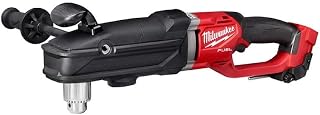


Choosing a Milwaukee angle drill is less about finding the most powerful specification and more about matching the drill's configuration to the work you actually perform. A tool intended for electrical rough-ins, for example, has different priorities from one used for plumbing, carpentry, renovation work, or occasional drilling in confined spaces.
For Canadian buyers, the comparison should include the drill's chuck or attachment system, motor type, battery platform, drilling capacity, ergonomics, control features, included accessories, and the availability of compatible batteries and chargers. Milwaukee's M18 FUEL right-angle range includes purpose-built options such as the HOLE HAWG and SUPER HAWG, while conventional M18 drill/drivers serve a broader range of drilling and fastening applications.
Two of the most important Milwaukee names to understand when shopping for a professional right-angle drill are HOLE HAWG and SUPER HAWG. They are not simply interchangeable versions of the same tool.
The M18 FUEL HOLE HAWG is designed around fast rough-in work where a relatively compact right-angle configuration is valuable. Milwaukee positions the current HOLE HAWG for electricians and professional tradespeople, with a focus on drilling repeated holes efficiently. The current M18 FUEL 2807-20 uses a 1/2-inch keyed chuck, while the 2808-20 configuration uses Milwaukee's QUIK-LOK chuck system.
For buyers who regularly drill through framing members for cable, conduit, plumbing lines, or other installations, the HOLE HAWG's combination of right-angle geometry and compact handling can be more useful than simply choosing a conventional high-torque drill.
The M18 FUEL SUPER HAWG is aimed at heavier-duty right-angle drilling. Milwaukee's current 2809-20 model uses an all-metal 1/2-inch keyed chuck, while the 2811-20 version adds a QUIK-LOK chuck system. The SUPER HAWG is designed to deliver the power and speed needed for demanding rough-in work, including larger holes through structural framing.
This makes the SUPER HAWG particularly relevant when hole diameter, drilling speed under load, and sustained productivity matter more than having the smallest possible right-angle drill.
The chuck is one of the most important specifications because it determines how bits are secured and which accessories can be used.
Do not assume that every right-angle drill accessory fits every Milwaukee model. Check the exact tool model and the manufacturer's compatibility information before buying specialty bits, augers, hole saws, or attachments.
Milwaukee M18 FUEL tools use a POWERSTATE brushless motor together with REDLINK PLUS electronics and REDLITHIUM battery technology. For buyers, the practical significance is more important than the marketing terminology: brushless motor technology is generally associated with efficient power delivery, while electronic controls can help manage overload, heat, and other demanding operating conditions.
When comparing drills, look beyond the motor label and consider what the complete system is designed to do under load. A drill that performs well in light-duty applications may not be the appropriate choice for repeated large-hole drilling.
Battery compatibility can have a major effect on the real cost of a cordless tool. Buyers already invested in Milwaukee M18 equipment may have a significant advantage because compatible batteries can potentially be shared across their existing M18 tools.
A bare-tool purchase can make sense when you already own suitable M18 batteries and a charger. A kit can be more practical when starting from scratch, but the included battery capacity, charger, case or bag, and other accessories should be compared rather than judging the kit only by its headline price.
Battery capacity is especially important for high-load drilling. Larger-capacity packs can provide greater runtime, although the ideal battery depends on the application, tool balance, access conditions, and the amount of drilling required.
Milwaukee publishes application-specific runtime claims for certain tools and batteries. For example, the current M18 FUEL HOLE HAWG and SUPER HAWG product information includes hole-per-charge figures under specified conditions. These figures should be treated as manufacturer test claims rather than a guarantee of the number of holes every Canadian user will achieve.
Never compare right-angle drills only by RPM. The maximum recommended hole size, accessory type, material, and intended application can be more important.
A right-angle drill changes the geometry of the tool so the motor and chuck sit at approximately 90 degrees to the main grip. This configuration can make it substantially easier to drill between studs, joists, framing members, cabinets, or other restricted spaces.
The advantage is not simply that the tool is shorter. The handle and motor arrangement can allow the operator to approach a drilling point that would be difficult or impossible to reach with a conventional drill/driver.
For professional users, this can reduce awkward positioning and make repeated rough-in operations more efficient. For occasional DIY users, however, a dedicated right-angle drill may be unnecessary if their projects rarely involve confined drilling locations.
A right-angle drill is a specialist tool. If your work consists mostly of everyday fastening, pilot holes, small woodworking projects, general maintenance, and drilling where access is unrestricted, a conventional Milwaukee M18 drill/driver may provide greater versatility.
For example, Milwaukee's M18 FUEL 1/2-inch Drill/Driver is designed as a general-purpose drilling and fastening platform rather than a dedicated right-angle rough-in tool. Comparing a conventional drill/driver with a HOLE HAWG or SUPER HAWG therefore requires considering the job geometry as much as raw power.
Right-angle drilling can generate substantial reaction forces, particularly when large accessories catch or bind. A properly positioned auxiliary handle can improve control and allow the operator to maintain a more stable stance.
Look for a configuration that lets you position both hands comfortably without interfering with the workpiece. The ideal setup varies according to whether you are drilling overhead, horizontally through framing, or from an awkward standing position.
Total weight is only one part of ergonomics. Balance matters because a drill that is technically lightweight can still feel tiring if the weight is positioned far from the operator's hands.
When comparing models, consider the complete working configuration rather than the bare-tool specification alone. A larger battery can change the balance and overall handling substantially.
High-torque drilling requires deliberate control. A side handle can provide an additional contact point for resisting rotational forces and maintaining alignment.
Do not treat a side handle as an optional convenience when performing heavy drilling. Use the manufacturer's recommended handle configuration and safe operating procedures, particularly when working with large-diameter bits.
Some Milwaukee right-angle drills incorporate a mechanical clutch or electronic protection features intended to help manage demanding applications. These systems should not be confused with a substitute for proper technique.
A clutch or protective electronic system can help respond to certain overload conditions, but operators still need to select the correct accessory, maintain proper footing, keep both hands positioned appropriately, and avoid forcing a bit beyond its intended application.
Integrated LED lighting is particularly useful when right-angle drilling takes place inside cabinets, between framing members, under floors, or in other poorly illuminated areas.
Lighting does not replace a dedicated work light when the work area is genuinely dark. Its main advantage is providing localized illumination around the drilling point without requiring the operator to reposition an additional light source.
Battery selection should be based on workload rather than simply choosing the largest available pack.
Before buying a kit, compare the battery model and capacity included in the package. Two kits that appear similar can have very different practical value if their batteries differ.
A bare tool is often the logical option for an established Milwaukee M18 user. You avoid paying for duplicate batteries and chargers while adding another tool to an existing battery ecosystem.
However, confirm that your existing batteries are appropriate for the application. Having an M18 battery does not automatically mean that every pack provides the same runtime or performance under sustained heavy loads.
A kit may be preferable for a new Milwaukee user because it can provide the drill, batteries, charger, and carrying equipment in one package.
Compare the actual contents carefully. The number of batteries, battery capacity, charger type, and included accessories can have more practical value than a small difference in the advertised kit price.
High RPM does not automatically mean better performance for large-hole drilling. Torque, motor characteristics, gearing, accessory design, and material all influence real-world drilling capability.
A professional right-angle drill can still perform poorly when paired with the wrong bit. Match augers, self-feed bits, hole saws, and other accessories to the material, hole diameter, shank configuration, and tool manufacturer's specifications.
More power is not always better. A large heavy-duty drill can be unnecessarily cumbersome for small or repetitive jobs where a more compact tool would be easier to control.
The price of a cordless drill is only part of the ownership equation if you need additional batteries and a charger. Compare the total system cost rather than the tool-only price.
Milwaukee uses closely related model names and model numbers across different generations and configurations. Older HOLE HAWG products, newer M18 FUEL versions, QUIK-LOK configurations, bare tools, and kits can look similar in retailer listings.
Always verify the complete model number before purchasing. This is particularly important when comparing Canadian listings, used tools, clearance products, and older inventory.
High-torque drilling requires more care than light-duty drilling. A large bit can catch suddenly when it contacts material or becomes obstructed, creating significant reaction force.
Canadian working conditions can make battery management more important than it is in moderate climates. Lithium-ion battery performance can be affected by very low temperatures, and manufacturers provide operating and storage guidance that should be followed.
When working in cold environments, avoid assuming that a battery will deliver the same runtime or charging behaviour that it provides indoors at normal room temperature. Follow Milwaukee's instructions for battery use, charging, storage, and temperature limits.
For contractors moving between heated vehicles, workshops, and outdoor jobsites, sensible battery storage and rotation can help maintain a more predictable workflow. Never attempt to charge a battery outside its specified temperature conditions.
Construction environments expose drills to dust, wood chips, metal particles, and other debris. Regularly remove accumulated material according to the manufacturer's cleaning guidance.
Check the chuck and attachment interface for visible damage, contamination, or abnormal movement. A damaged chuck can affect bit retention and drilling accuracy.
Dull or damaged bits increase load on the motor and can make drilling less controlled. Replace accessories when they are worn, damaged, or no longer appropriate for the application.
Store batteries according to Milwaukee's recommendations and avoid exposing them unnecessarily to extreme heat, moisture, impact, or freezing conditions.
Unusual noise, excessive vibration, repeated thermal shutdowns, visible damage, or abnormal chuck behaviour should not be ignored. Stop using a tool that appears unsafe and consult the manufacturer's service guidance or an appropriately qualified service provider.
Customer reviews can provide useful information, but they should be interpreted carefully. A five-star rating alone does not establish that a particular model is the best choice for every trade.
Retailer listings can vary in how they display model numbers and package contents. Before buying, compare the exact manufacturer model number, not just the retailer's shortened product title.
Check whether the listing is for a bare tool, a kit, a previous-generation model, or a tool bundled with a particular battery configuration. Also verify the stated warranty information, retailer return policy, and current Canadian availability independently before ordering.
A Milwaukee right-angle drill makes the most sense for buyers who regularly encounter restricted drilling spaces and need a purpose-built cordless solution. Electricians, plumbers, carpenters, renovators, remodelers, and other tradespeople can benefit when repeated drilling through framing or other difficult-to-access locations is a normal part of the job.
For a homeowner who only occasionally drills a few holes, the additional cost, size, and specialization may not be justified. In that situation, a versatile conventional drill/driver may provide better overall utility.
There is no single best model for every electrician. A current M18 FUEL HOLE HAWG is particularly relevant when compact right-angle drilling and repeated rough-ins are priorities, while a SUPER HAWG is better suited to applications demanding greater drilling capacity and heavier-duty performance. The appropriate choice depends on hole size, workload, access, and battery requirements.
It depends on the job. A HOLE HAWG is purpose-built for right-angle drilling and can be substantially more practical when working between framing members. A conventional drill/driver is generally more versatile for everyday drilling and fastening.
The HOLE HAWG emphasizes compact right-angle rough-in drilling, while the SUPER HAWG is designed for more demanding and larger-hole applications. Both belong to Milwaukee's M18 FUEL family, but they serve different workload priorities.
Milwaukee offers cordless M18 FUEL right-angle drills, including the HOLE HAWG and SUPER HAWG families. These tools use Milwaukee's M18 battery platform rather than requiring a permanent power cord.
QUIK-LOK refers to Milwaukee's chuck or attachment interface designed to make compatible accessory changes faster and easier. Buyers should verify the exact compatibility requirements for their chosen bits and attachments before purchasing.
M18 compatibility is an important advantage of the platform, but battery capacity and technology can affect performance and runtime in demanding applications. Check the manufacturer's recommendations for the specific drill and application rather than assuming every battery will provide identical results.
A bare tool can be an economical choice if you already own suitable M18 batteries and a compatible charger. If you do not own the platform, a kit may offer better practical value because it can include the batteries and charging equipment needed to operate the drill.
Yes, appropriate Milwaukee right-angle drills can be useful for woodworking applications where access is restricted. The correct bit, hole diameter, material, and tool configuration should always be selected according to the manufacturer's specifications.
They can be useful for plumbing rough-ins and other applications requiring holes through framing. The correct model depends on the required hole size, material, frequency of use, and available working space.
Prioritize the correct drilling capacity, battery platform, ergonomics, chuck system, durability, and application-specific performance. For outdoor or winter work, also pay attention to Milwaukee's published battery temperature, storage, and charging guidance.
There is no universal service interval that applies to every usage pattern. Inspect the drill regularly, keep it clean, follow Milwaukee's maintenance instructions, and seek qualified service when abnormal operation, damage, or other problems occur.
The best Milwaukee right-angle drill is the one that matches the actual drilling conditions rather than simply having the highest headline specification. For compact professional rough-ins, the M18 FUEL HOLE HAWG family deserves close consideration. For larger and more demanding right-angle drilling, the M18 FUEL SUPER HAWG family is the more appropriate category to investigate.
Before purchasing in Canada, compare the exact model number, chuck configuration, drilling capacity, battery requirements, kit contents, ergonomics, and current retailer pricing. Then read detailed customer feedback and verify the manufacturer's specifications for the exact configuration you intend to buy. This approach makes it easier to identify a Milwaukee angle drill that fits your workload, budget, and existing M18 tool collection without paying for capabilities you will rarely use.