

♥ Wishlist
Compare 9 Makita Cordless Caulking Guns products in Canada. Reviews, ratings, pros, cons and buying advice updated for October 2026.


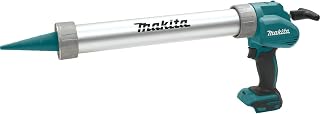


Choosing a precision Makita cordless caulking gun is less about finding the most powerful tool and more about matching the dispensing system to the materials, container sizes, application speed and level of control required for the job. A good cordless caulking gun should make it easier to maintain a consistent bead while reducing hand fatigue, particularly when working with high-viscosity sealants or adhesives.
For Canadian buyers, the most important considerations include 18V LXT battery compatibility, cartridge capacity, dispensing-force requirements, variable-speed control, container format, tool balance and the availability of compatible accessories. Makita's 18V LXT caulking-gun platform includes configurations designed around 10 oz., 20 oz. and 29 oz. applications, with different holder arrangements affecting the materials that can be used.
The Makita XGC01 family is particularly important when comparing cordless caulk and adhesive guns. Rather than treating every configuration as a completely different tool, it is useful to understand the differences between barrel sizes and included equipment.
Model numbers and package contents can vary by market, retailer and kit configuration. Canadian shoppers should therefore compare the exact model number, included battery, charger, holder and accessories rather than assuming that similarly named listings contain identical equipment.
Dispensing force determines how effectively a caulking gun can push material through the nozzle. This becomes particularly important with thick construction adhesives, high-viscosity sealants and materials that become more resistant to extrusion in cooler working conditions.
Makita's XGC01 platform is specified with a dispensing force of up to 1,100 lb. This is substantially different from judging a caulking gun solely by its battery voltage. Voltage describes the electrical platform; dispensing force is much more relevant when determining whether the tool can push a demanding material consistently.
High dispensing force is not automatically better for every application. A tool capable of pushing very thick material still needs appropriate speed control. Excessive flow can create oversized beads, increase cleanup and waste material, and make precision finishing more difficult.
A precision caulking gun should provide enough control to match material flow with the application. The Makita XGC01 platform uses a five-speed dial combined with a variable-speed trigger, giving the operator two layers of control over dispensing speed.
The speed dial establishes the general operating range, while trigger pressure can be used to fine-tune the amount of material being dispensed. This is valuable when moving between large construction joints and smaller finishing applications.
Makita specifies a flow range of 0 to 66 inches per minute for its XGC01 configurations. The practical speed you need will depend heavily on the material's viscosity, nozzle opening, joint dimensions and how quickly you can move the tool along the work surface.
Very slow dispensing can make it difficult to maintain a consistent travel speed. Very fast dispensing can overwhelm the joint and produce an unnecessarily thick bead. The objective is to find a balance between material flow and hand movement.
Container capacity is one of the easiest specifications to overlook. A larger barrel is not necessarily the better choice because it can increase overall tool size and may be unnecessary for smaller residential jobs.
A 10 oz. configuration is a logical choice for conventional cartridge-based work. It can make sense for general maintenance, trim work, smaller renovation projects and applications where portability is more important than maximum material capacity.
Makita's compatible 10 oz. cartridge holder system is designed around 10 oz. and 300 ml cartridges. Before purchasing, confirm that the holder supplied with the exact listing matches the cartridge format used by the sealants you normally buy.
A 20 oz. barrel provides a useful middle ground for users who regularly work with larger quantities of material. It can also offer greater flexibility when the appropriate holder and piston configuration is used.
Makita's 20 oz. system is designed to accommodate cartridge-style materials, sausage packs and bulk caulk or adhesives when the appropriate components are installed. This makes it particularly interesting for professionals who work with more than one material format.
A 29 oz. configuration is aimed more toward high-volume applications. Larger cartridges can reduce the number of reloads during extended work, which can be valuable when sealing long runs or completing repetitive installation work.
The trade-off is size. If most of your work involves small tubes or short joints, carrying a larger dispensing assembly may provide little practical advantage.
Container compatibility should be checked before buying a cordless caulking gun. Sealants and adhesives are sold in several packaging formats, and a tool designed for one format may require an additional holder or piston assembly to handle another.
Makita accessory options include dedicated holder systems for different capacities. For example, a 10 oz. holder set and larger barrel-holder configurations are available within the XGC01 accessory ecosystem. Always verify compatibility with the exact model and configuration before ordering accessories.
Drip reduction is an important feature for anyone who cares about clean joints and minimizing wasted sealant. When the trigger is released, continued forward pressure on the material can cause unwanted extrusion. A pressure-relief or drip-reduction mechanism helps reduce this effect.
Makita's XGC01 configurations include drip-reduction functionality designed to relieve pressure on the material when dispensing stops. This does not eliminate the need for proper trigger control or finishing technique, but it can make repeated stopping and starting cleaner.
Remember that material waste depends on more than the gun. Oversized nozzles, excessive flow, incorrect joint dimensions, poor cutting technique and unnecessary reapplication can all increase consumption.
If you already own Makita 18V LXT tools, platform compatibility can be one of the strongest reasons to choose an LXT caulking gun. A tool-only configuration can be more practical when suitable batteries and a charger are already part of your workshop.
However, buyers new to the platform should calculate the complete setup cost rather than looking only at the bare-tool price. A tool-only caulking gun may require a compatible battery and charger before it can be used.
Battery amp-hour capacity affects how much energy the battery stores, but a larger battery can also add weight. For a caulking gun, this matters because the tool is often held in one hand while the operator maintains a consistent angle and travel speed.
A compact battery can make sense when the job involves frequent movement, overhead work or short applications. A higher-capacity battery may be preferable when the tool is used continuously for extended periods and minimizing battery changes is more important.
Rather than choosing the largest available battery automatically, consider the relationship between runtime, weight, balance and the amount of material you expect to dispense during a typical work session.
Caulking is a control-intensive task. The operator is not simply activating a motor; they are controlling bead size, travel speed, nozzle angle and stopping points simultaneously. Poor balance can therefore become noticeable over a long installation.
Look for a grip that allows a secure trigger position without forcing the wrist into an awkward angle. Rubberized grip surfaces can also improve handling, especially when gloves are worn.
The barrel determines not only capacity but also how the material is loaded and how versatile the gun can be. A dedicated cartridge holder may be preferable for straightforward applications, while a barrel-style system can provide more flexibility for users who work with different packaging formats.
For professionals, versatility can justify a more complex setup. For occasional users, however, a simple configuration may be easier to load and maintain.
The best cordless caulking gun cannot compensate for poor surface preparation or inconsistent technique. Precision results depend on the complete application process.
The nozzle opening directly influences the amount of material that can be deposited. A small opening can provide better control for narrow joints, while a larger opening can make sense for wider joints and higher-volume applications.
Cutting the nozzle too large is a common mistake because it encourages the operator to compensate by moving faster. This can lead to excess sealant, messy edges and increased material consumption.
The correct opening should be determined by the joint dimensions and the sealant manufacturer's application requirements rather than by the maximum dispensing speed of the tool.
Canadian working conditions make temperature an especially important consideration. Sealants and adhesives can behave differently as temperatures change. A material that flows easily in warm conditions may become considerably more resistant when cold.
This means a cordless caulking gun should not be evaluated in isolation from the material being dispensed. Always follow the sealant or adhesive manufacturer's specified storage, application and temperature requirements.
A high-force dispensing gun can help overcome material resistance, but it does not change the manufacturer's requirements for application temperature, curing conditions or surface preparation.
Makita is not the only established power-tool manufacturer producing cordless dispensing equipment. Depending on the user's existing battery platform and material requirements, alternatives from Milwaukee, DEWALT and Ryobi may also be worth comparing.
Makita is particularly compelling for users already invested in the 18V LXT ecosystem. The XGC01 range provides multiple capacity configurations and focuses heavily on controlled dispensing for caulk and adhesives.
Milwaukee cordless caulking guns are worth considering for users already invested in the M18 battery platform. Buyers should compare the exact dispensing force, speed-control system, container compatibility and kit contents rather than choosing solely by brand.
DEWALT offers cordless dispensing tools for users within its battery ecosystems. A comparison should include battery platform, thrust or dispensing force, cartridge compatibility, speed adjustment and overall ergonomics.
Ryobi can be attractive to buyers who already use its cordless platform. For occasional use, platform convenience and overall ownership cost may be more important than maximum dispensing force.
The best brand is therefore not universal. A professional who already owns several compatible batteries may benefit from staying within that platform, while a first-time buyer should compare the complete tool-and-battery system.
A 29 oz. configuration can be useful for high-volume work, but it may be unnecessarily large for routine household or light renovation applications.
Do not purchase a tool before checking whether it accepts the exact cartridge, sausage pack or bulk material format you intend to use.
Two cordless tools can operate on similar voltage platforms while providing very different dispensing characteristics. Compare force, speed control, capacity and mechanical design.
A tool-only listing is not equivalent to a complete kit. Confirm everything included in the exact package.
Fast dispensing is useful for large jobs but is not necessarily desirable for detailed finishing work. Precision requires controllable flow.
A caulking gun may feel comfortable for five minutes but become tiring during a full day of repetitive applications. Consider the tool with the battery installed.
Holder sets, pistons and barrels should be checked against the exact model number. Similar-looking accessories are not automatically interchangeable.
A Makita cordless caulking gun is particularly worth considering for contractors, installers, renovators, maintenance professionals and serious DIY users who regularly dispense sealants or adhesives and already have compatible Makita batteries.
It can also make sense for users who experience hand fatigue with conventional manual caulking guns or who need more consistent material flow across long runs.
For a homeowner who applies a few tubes of sealant only once or twice a year, a manual caulking gun may remain the more economical and practical choice. Cordless dispensing equipment becomes easier to justify as application frequency, material viscosity and project scale increase.
When two listings appear similar, compare them in the following order:
Precision comes from the combination of controlled extrusion, consistent trigger response, appropriate nozzle size, predictable material flow and operator technique. A high-force motor alone does not guarantee a precise bead.
The most useful setup is one that lets the operator slow the material flow enough to match the movement of the hand. This is especially important around corners, joints, trim, fixtures and finished surfaces where excess sealant is difficult to remove cleanly.
Proper maintenance is important because cured sealant can interfere with moving components and loading mechanisms. The precise cleaning procedure depends on the material being dispensed, so the sealant or adhesive manufacturer's instructions should take priority.
Always read the caulking gun's instructions and the material manufacturer's safety information before use. The tool and the sealant have separate safety requirements, and both need to be considered.
If your projects mainly involve ordinary 10 oz. cartridges, start by evaluating the 10 oz. configuration. If you frequently use larger material packages or need greater flexibility, investigate the 20 oz. barrel system. For long, repetitive applications where reducing reload frequency matters, the 29 oz. configuration may be more appropriate.
The correct choice should follow the materials you actually use rather than the largest specification available.
There is no single best configuration for every Canadian buyer. A 10 oz. model can be appropriate for conventional cartridge work, while 20 oz. and 29 oz. configurations can make more sense for larger-volume or more demanding applications. The right choice depends on the material format, project frequency and battery platform you already own.
Yes. Makita's XGC01 platform is designed for both caulk and adhesive dispensing. However, the material must be compatible with the specific holder, cartridge or barrel configuration, and the adhesive manufacturer's application requirements should always be followed.
The XGC01 platform is specified with up to 1,100 lb. of dispensing force, making it designed for demanding caulk and adhesive applications. Actual performance depends on the material, temperature, cartridge condition, nozzle opening and application setup.
The primary advantages are reduced repetitive hand pressure, more consistent dispensing control and easier handling during long applications. These advantages become more significant when working with high-viscosity materials or applying many cartridges in succession.
A tool-only version can be a sensible choice when you already own compatible Makita batteries and a charger. If you are entering the battery platform for the first time, compare the cost of the complete kit before deciding.
Not necessarily. The 29 oz. configuration offers greater material capacity, while the 10 oz. configuration can be more appropriate for conventional cartridge applications. Bigger capacity is useful only when it matches the material and workload.
Compatible Makita barrel and holder configurations can support sausage-pack materials. The exact compatibility depends on the model and installed components, so check the manufacturer's specifications for the exact configuration.
Very important for precision work. A speed dial establishes a controllable dispensing range, while trigger pressure can provide additional adjustment. This makes it easier to match material flow with movement along the joint.
Prioritize exact model compatibility, container capacity, dispensing force, speed control, battery requirements, included accessories, working weight and compatibility with the materials you use. Also verify the current Canadian listing and package contents before purchase.
No. Accessories should be matched to the exact model and barrel configuration. Makita offers different holder sets for different capacities, so compatibility should be confirmed before buying an accessory.
The best precision Makita cordless caulking gun is the configuration that matches your material, container format and workload without adding unnecessary size or cost. Start with the type of sealant or adhesive you use, determine the required cartridge or barrel capacity, then compare dispensing force, speed control, battery requirements and ergonomics.
For Canadian buyers, it is especially important to check the exact model number and package contents because tool-only versions, battery kits, barrel configurations and accessory packages can differ. A careful specification comparison is more useful than choosing solely from a headline such as “most powerful” or “best overall.”
Before making a purchase, compare the current specifications, Canadian retailer listings, complete package contents and recent customer feedback for the exact model. This approach helps ensure that the Makita cordless caulking gun you choose is appropriate for the materials and applications you actually encounter.